




The accelerated growth of the M2 money supply during April and May will contribute to an increase in the U.S.’s overall M3 money supply, which was already at record levels.
The excessive hypertrophy of this U.S. money supply will logically and inevitably lead to a decline in real GDP in the near future.
As a reminder, a nation’s money supply in circulation must not exceed a certain limit relative to wealth creation—that is, GDP.
Sound money is the first pillar of Reaganomics, according to Arthur Laffer, and this also aligns with my law on the free money supply.
***
The month-over-month increase in the U.S. M2 monetary aggregate had been fluctuating within an upward range of $50 to $100 billion since the end of 2022, and it rebounded sharply during the month of May 2026 (latest figures published to date), reaching a peak of 247.8 billion dollars, following an increase of 118.3 billion dollars in April—that is… 366.1 billion over the last two consecutive months!
Document 1:
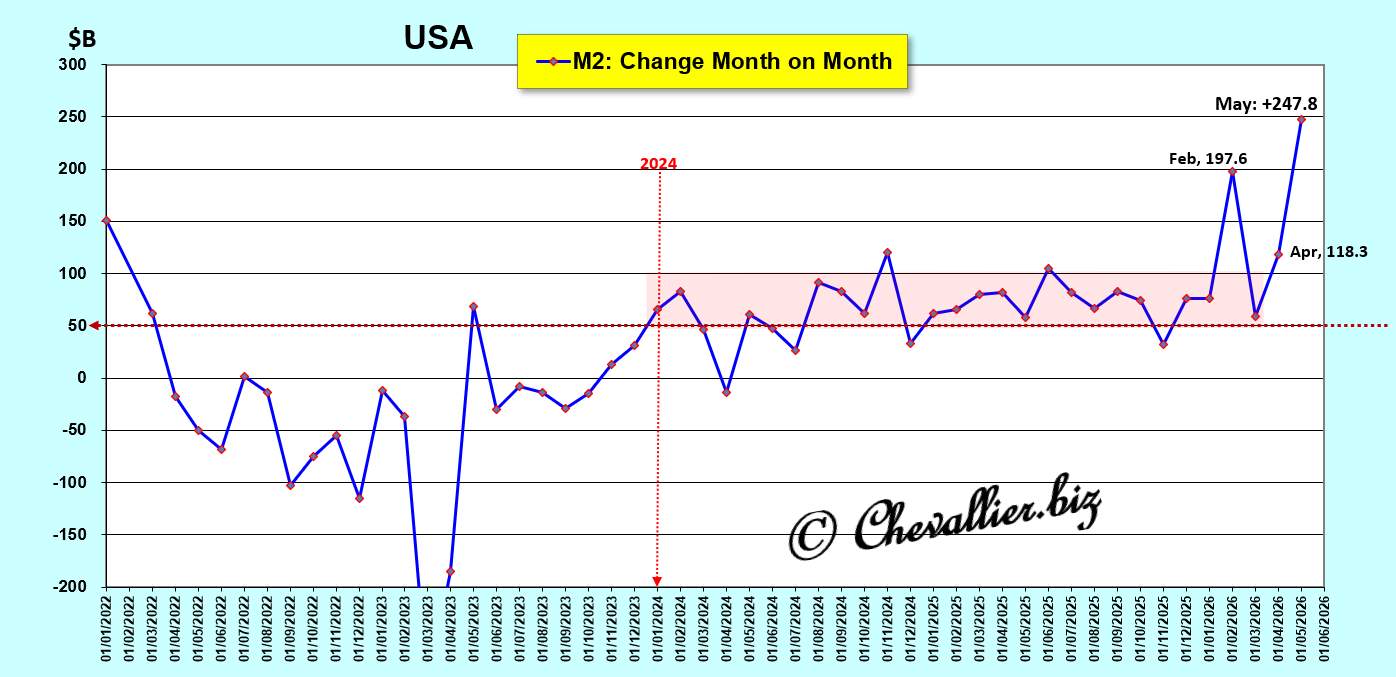
In other words, and more specifically, after fluctuating within a flat range in 2025, an upward trend in the M2 monetary aggregate has continued over the long term beginning in 2022, with a very sharp upward trend in May of this year.
Month-over-month variations in the M2 monetary aggregate were modest during the 20th century, but everything changed starting in the year 2000: these fluctuations have become completely out of the ordinary, especially in 2020 (due to COVID) and in 2023 as a result of the stress caused by the collapse of three U.S. banks that were rescued from bankruptcy under extraordinary circumstances.
The increase in the M2 money supply of approximately $250 billion during the month of May 2026 alone corresponds to an increase in so-called precautionary savings on the part of Americans who fear that the war waged by the United States and Israel against Iran will create a situation that will be highly detrimental to them,
Document 2:
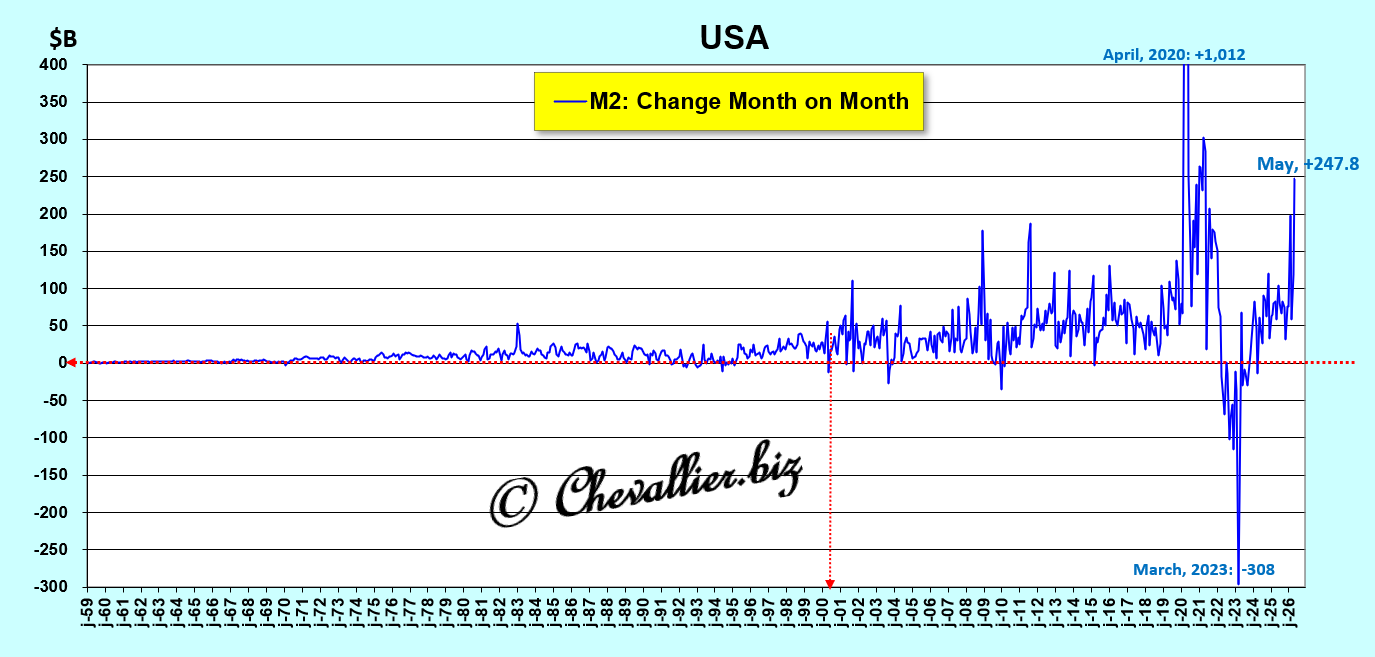
This is a normal reaction on the part of Americans, who are thus setting money aside to cope with a decline in their standard of living in the near future.
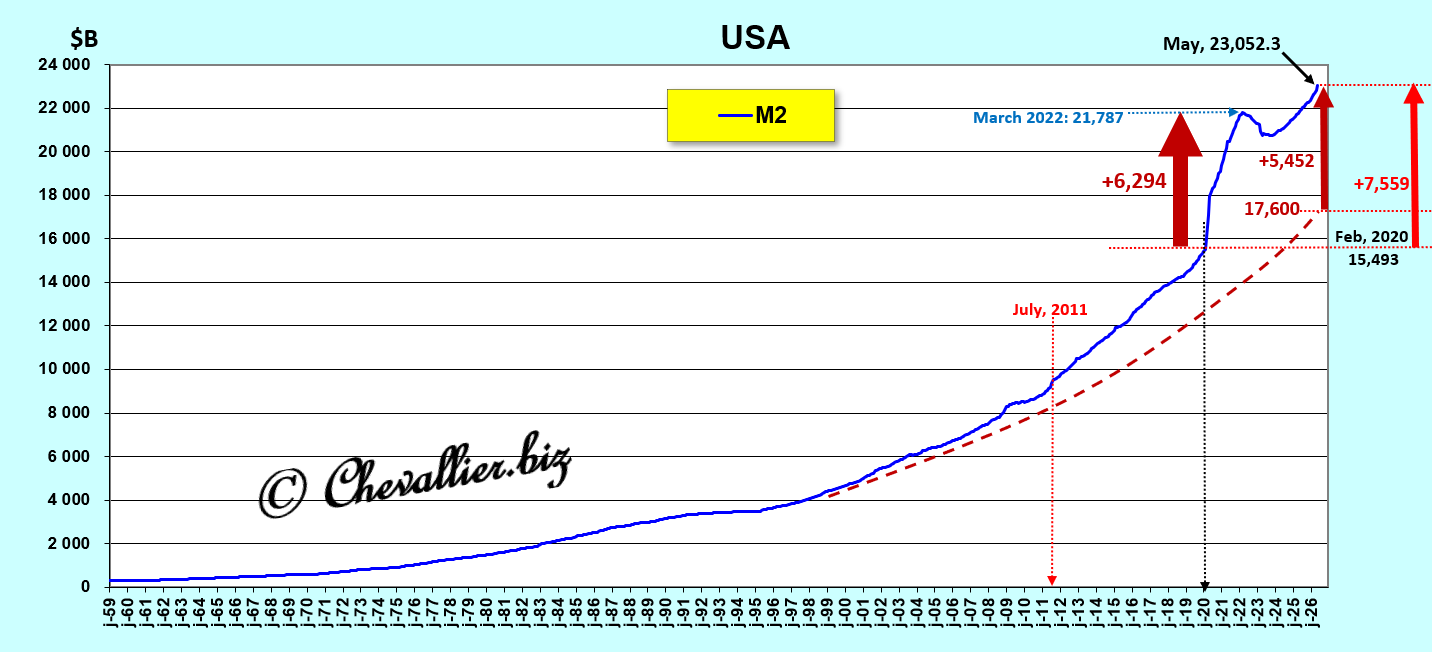
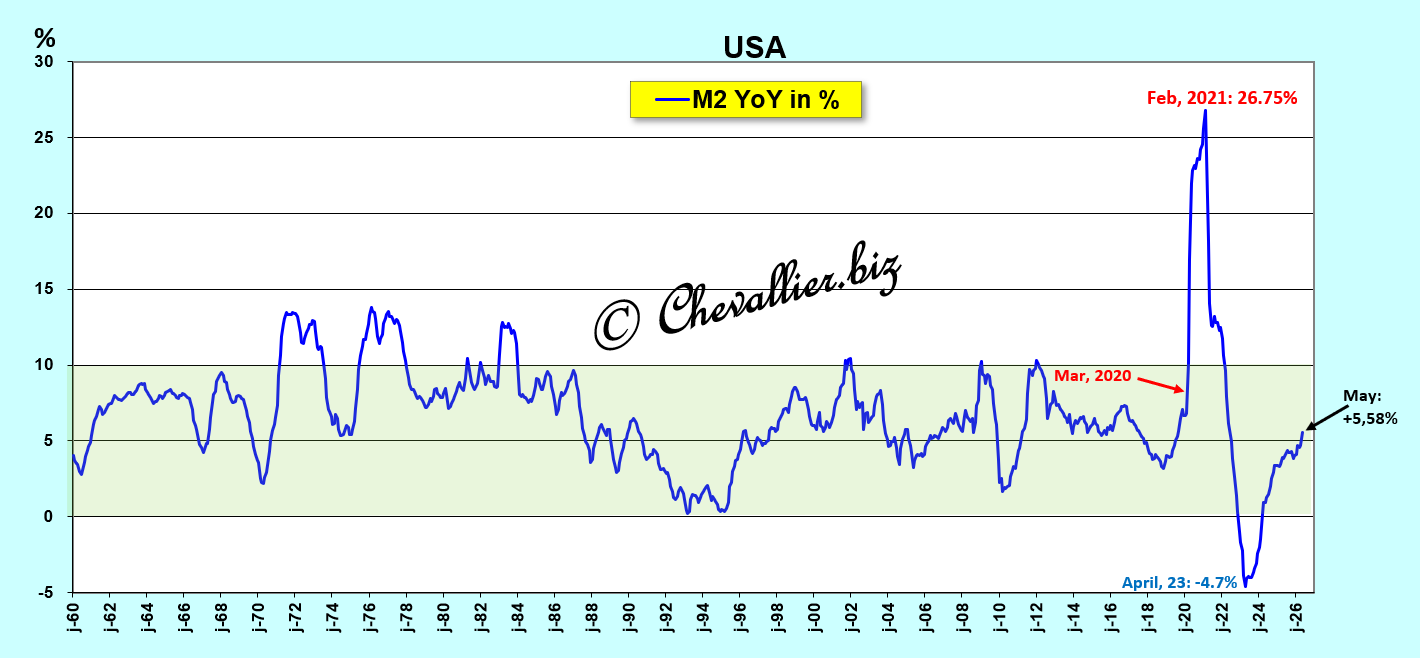
In absolute terms, the growth of this M2 monetary aggregate has once again far exceeded its long-term trend (dotted line).
At the end of May 2026—the latest figures published to date—this M2 monetary aggregate reached a total of 23,052.3 billion dollars, of which…5,452 billion dollars are outside the norm, mainly due to 7,759 billion dollars unduly in circulation as a result of COVID,
Document 3:
A closer look at the recent period shows that the rise in this M2 monetary aggregate has accelerated significantly compared to its previous linear trend,
Document 4:
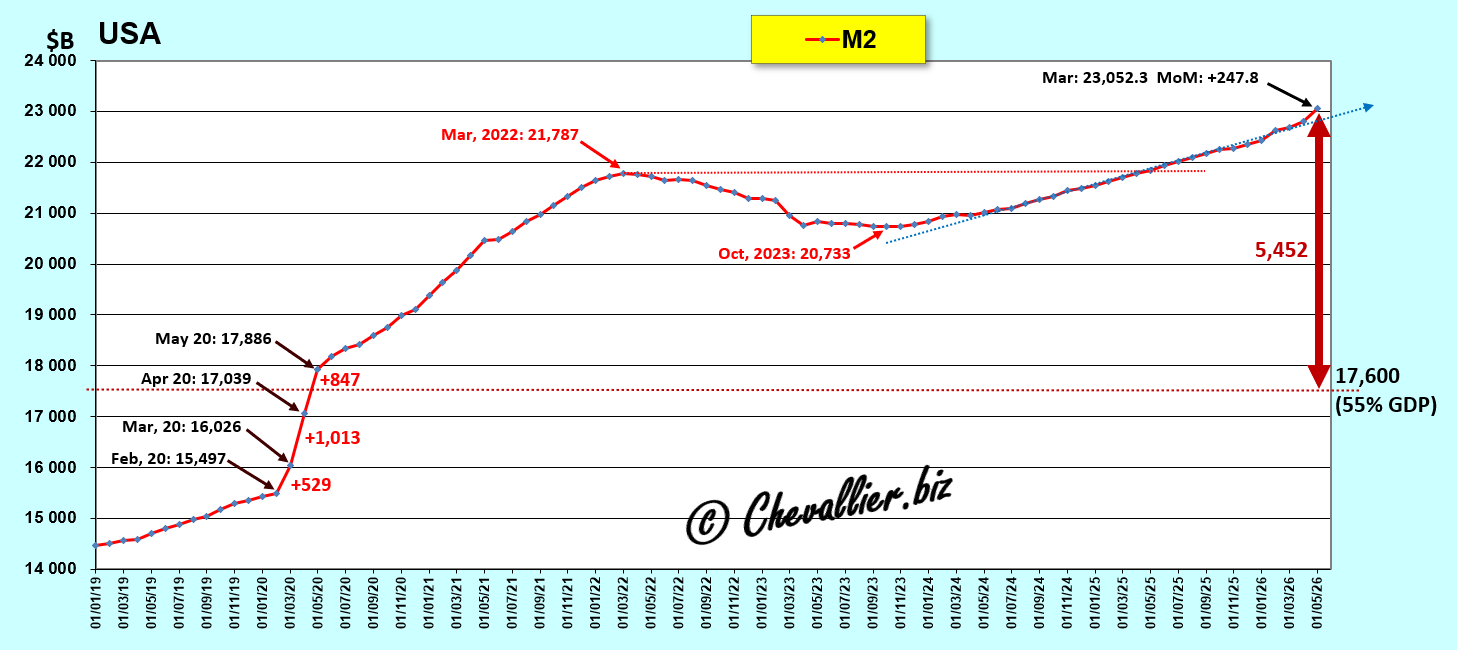
As a reminder, according to standards defined based on observations of changes in monetary aggregates since these data began being published (1959), the value of this M2 monetary aggregate should not exceed 55% of current annual GDP.
These standards were more or less adhered to for 50 years but were exceeded following the Great Recession of 2008, skyrocketing in 2020 without returning to an acceptable range.
This M2/GDP ratio, expressed as a percentage, has clearly and dangerously begun to rise again during the month of May 2026, and this situation is expected to worsen further in the foreseeable future,
Document 5:
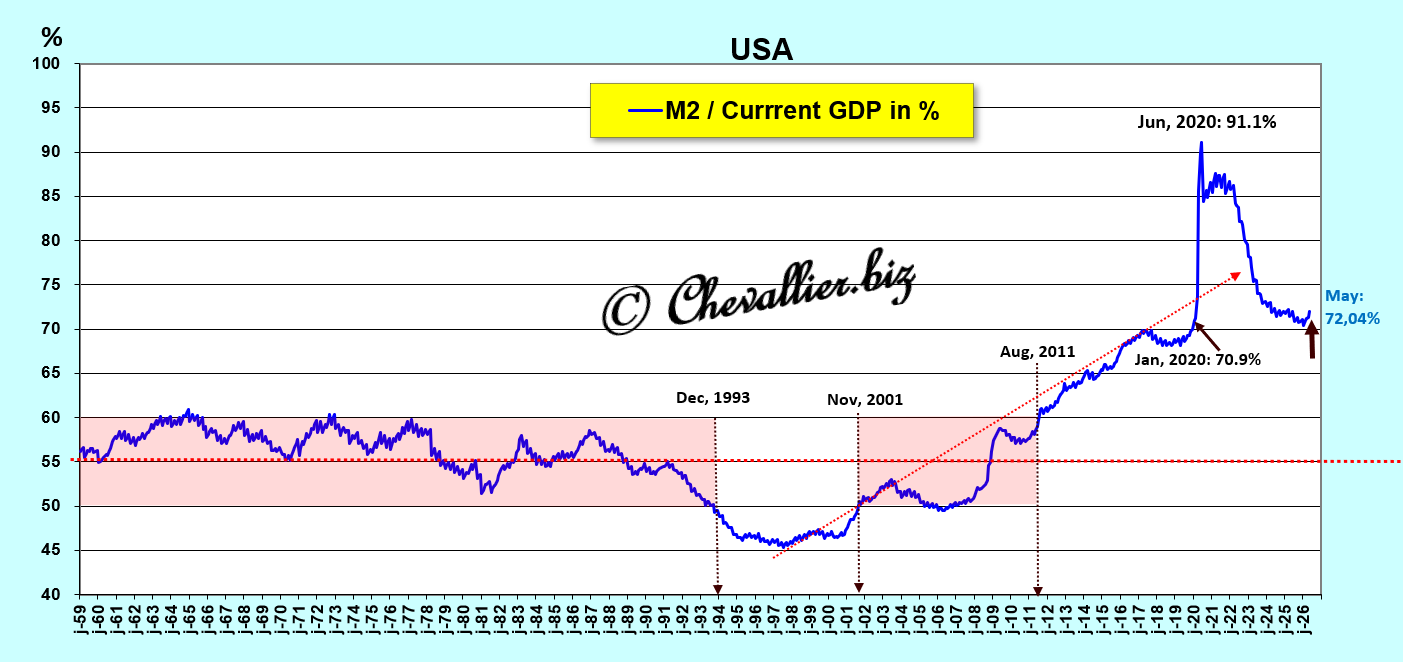
This year-over-year increase in the M2/GDP ratio (as a percentage) may appear normal, but because this ratio has exceeded the standard since 2011, the money supply remains outside the normal range,
Document 6:
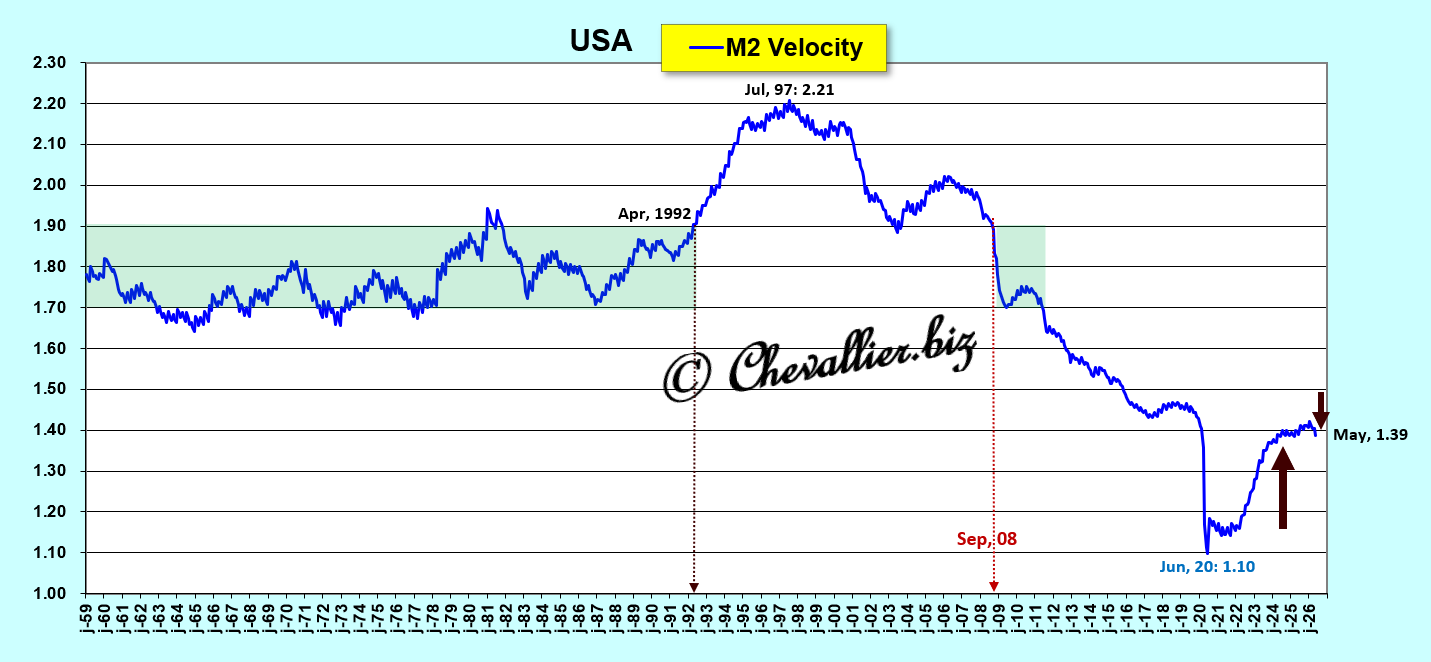
The velocity of money, which is the GDP/M2 ratio—that is, the inverse of the M2/GDP ratio (as a percentage)—calculated using the M2 monetary aggregate, had been fluctuating within a flat trend, but a trend reversal occurred during the last two months under review.
Document 7:
***
These data, once clarified and analyzed, help us understand the relationship between changes in a nation’s money supply and changes in its real GDP…
To put it simply, an increase in this M2 money supply held by Americans leads to a decline in real GDP, and vice versa, a pattern that holds true over the long term, ever since these data have been published by FRED of St. Louis.
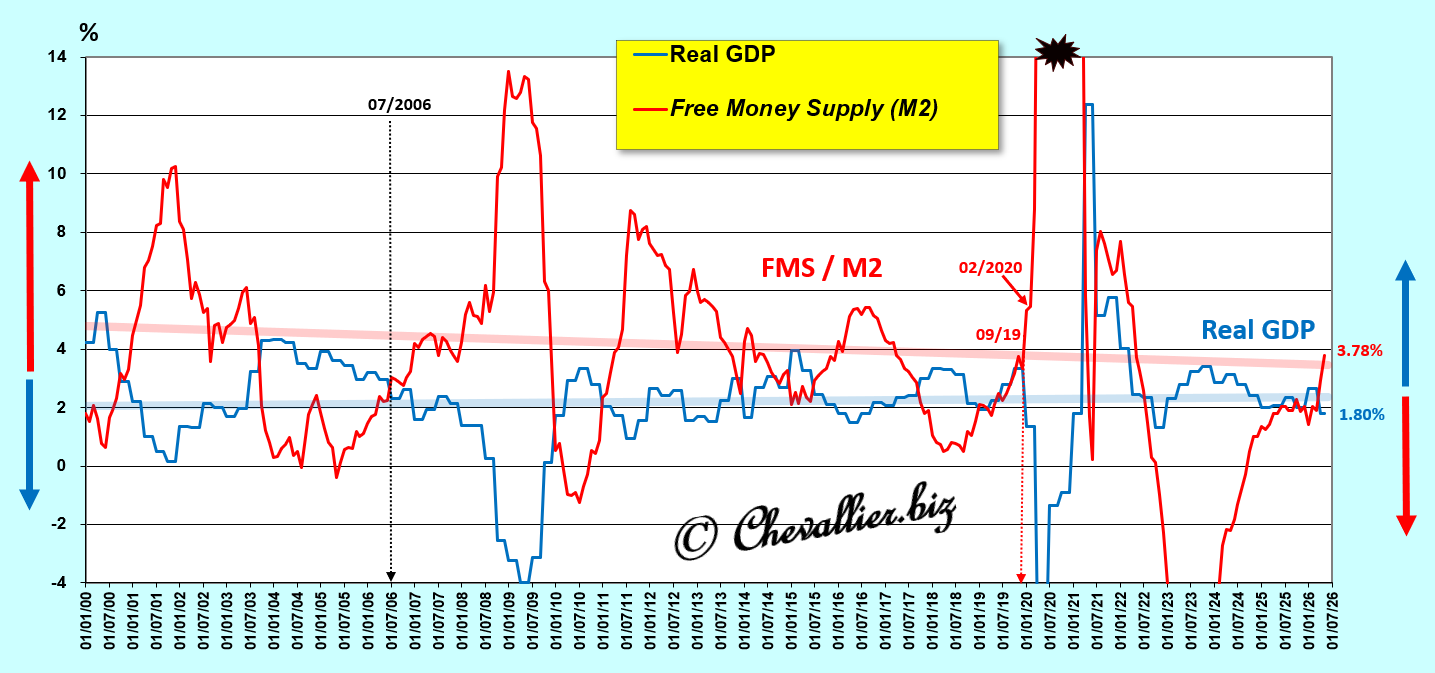
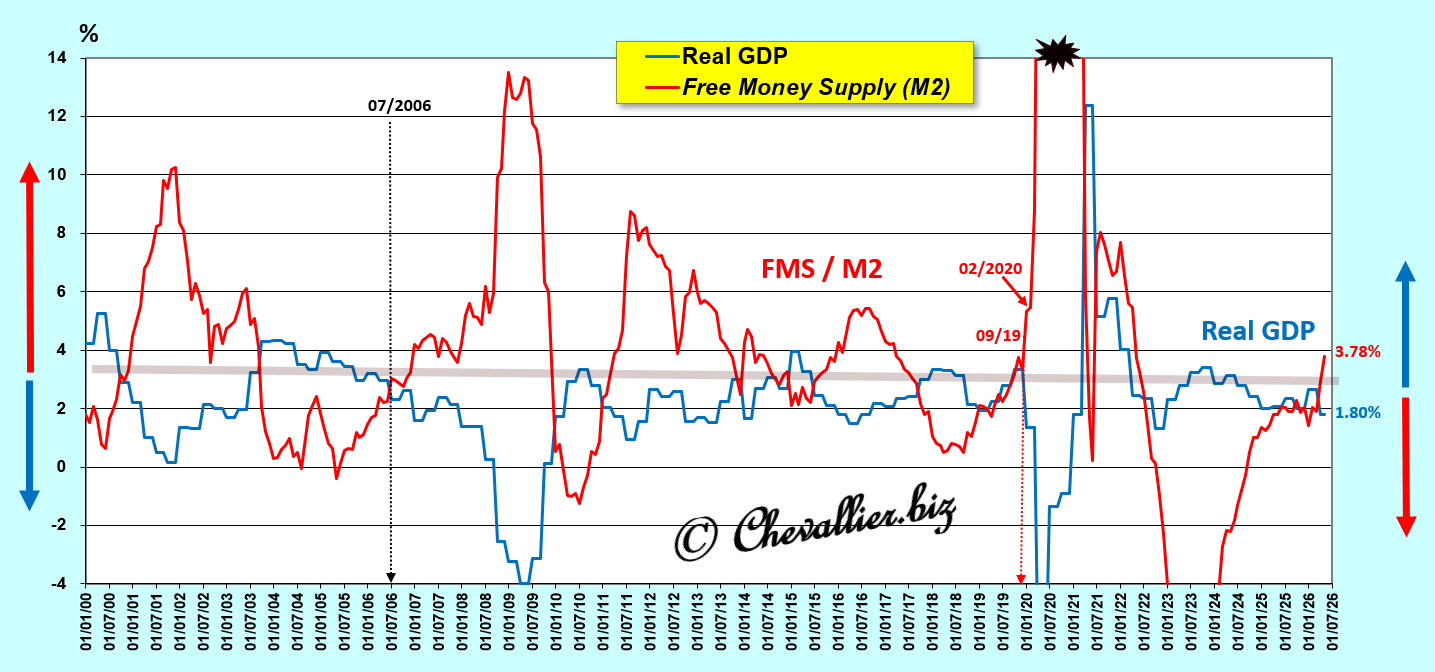
More specifically, it is the change in what I call the free M2 money supply—which is the difference between, on the one hand, the change (year-over-year in percentage terms) in the M2 monetary aggregate, and, on the other hand, (minus) the change in real GDP (year-over-year in percentage terms)—that causes an inverse reaction in real GDP.
The $366 billion increase in the M2 monetary aggregate during April and May thus began to drive the free money supply up to 3.78%, but real GDP may not have declined due to overinvestment in the artificial intelligence sector.
Document 8:
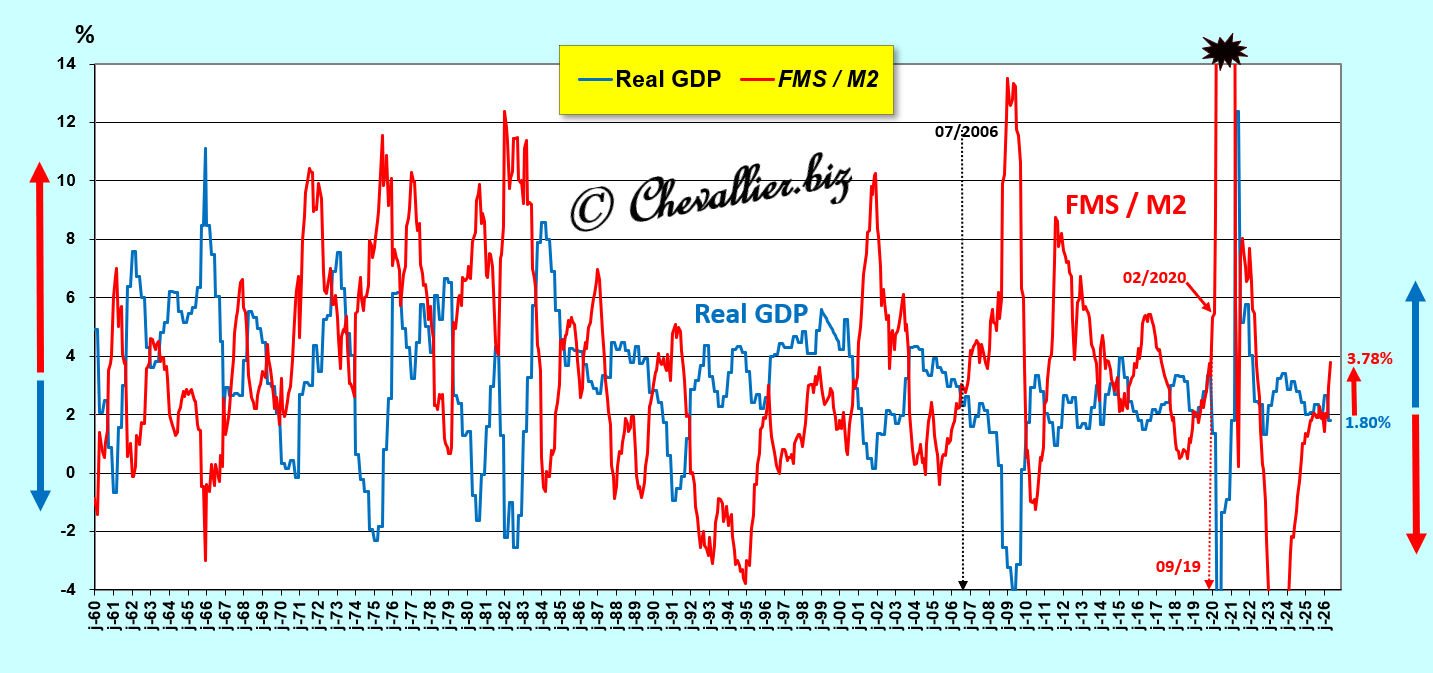
A closer look at the recent period since the early 2000s shows more precisely that the very significant increase in the M2 monetary aggregate in May should have caused a decline in GDP, but this did not occur because GDP was boosted by investments in artificial intelligence.
Document 9:
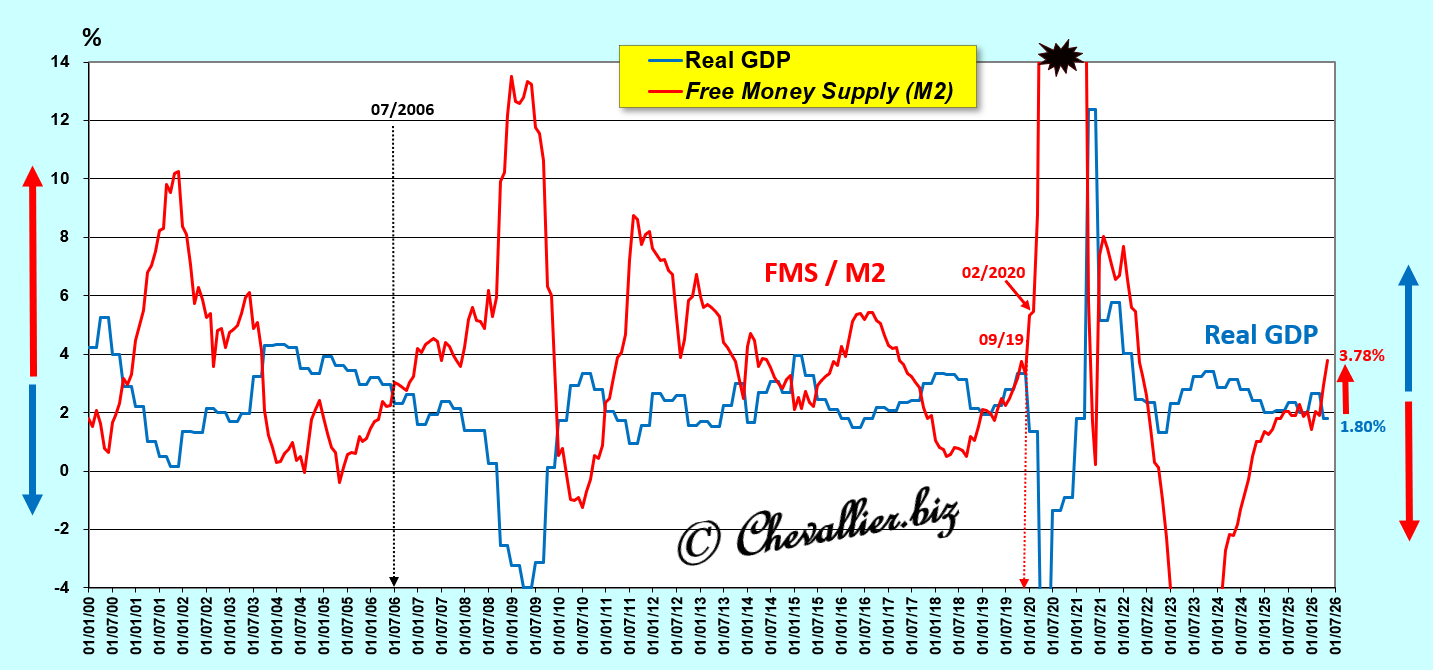
This law regarding the free money supply is well-established, as shown by the arithmetic trend lines of the changes in the free money supply and real GDP, which are nearly parallel (though slightly converging and declining), falling from approximately 5.0% and 2.0% in 2000 to 3.5% and 2.0%, respectively, at the end of last May,
Document 10:
Logically, the line serving as the axis of symmetry between these curves remains virtually stable at around 3.0% over this period in the first quarter of the 21st century, which confirms the significance of this free money supply!
Document 11:
The increase in the M2 monetary aggregate should logically continue in the coming months, particularly due to the inflation caused by this war against Iran, which will exacerbate the decline in GDP in the United States and elsewhere around the world due to shortages of certain hydrocarbon-related products and disruptions in supply chains.
***
As a reminder…
Analyses and conclusions regarding the impact of changes in monetary aggregates on real GDP have not been taken into account by financial market participants for the past twenty years or so, even though these are the very issues and solutions that underpin the economic activity of any nation.
This is why Ben Bernanke took care to ensure that the Fed would no longer publish weekly figures for the M1, M2, and M3 monetary aggregates from the moment he took office as chairman of the Fed in February 2006.
Subsequently, Jerome Powell added another layer of opacity by publishing only monthly data for the M2 monetary aggregate.
Thus, only those acting from within have access to this fundamental data, and they can manipulate financial reporting and the financial markets as they see fit!
This increase in the M2 monetary aggregate can be explained by the fact that Americans had already anticipated in May a possible further deterioration in their financial situation and thus increased their precautionary savings (M1-M2) overall.
These Americans are the consumers and savers who form the foundation of economic activity, and they are also voters who can express their dissatisfaction in the upcoming midterm elections.
***
Click here to read my previous article on this topic.
Click here to read my article on my website in French.
© Chevallier.biz