




The actual net debt of the U.S. federal government is neither abnormal nor out of control. It is the subject of public opinion manipulation by certain entities. It obscures the significance of a $13,000 billion monetary bubble!
***
The U.S. government publishes the gross federal debt figure daily, which as of July 12, 2026, stands at… 39,414 billion dollars (Total Public Debt Outstanding, circled in red)—a figure that is considerable and frightens everyone!
Document 1:
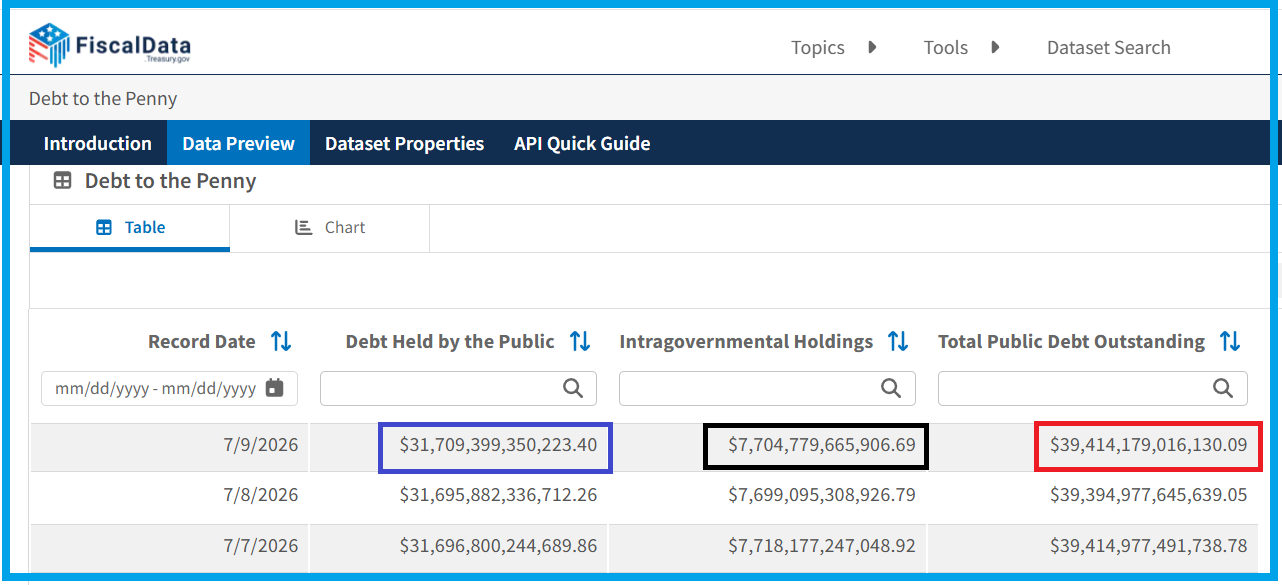
However, this document shows that government entities (Intragovernmental Holdings) hold 7,705 billion dollars of this federal debt (circled in black), which means that the federal government has both these debts and these claims on… itself!
To determine the actual amount of its net debt, we must subtract from the amount of its gross debt the amount of debt it holds on itself—that is, these 7,705 billion dollars (circled in blue)—which brings the actual net federal debt down to 31,709 billion dollars (Debt Held by the Public, circled in blue).
[38,968 – 7,705 = 31,709]
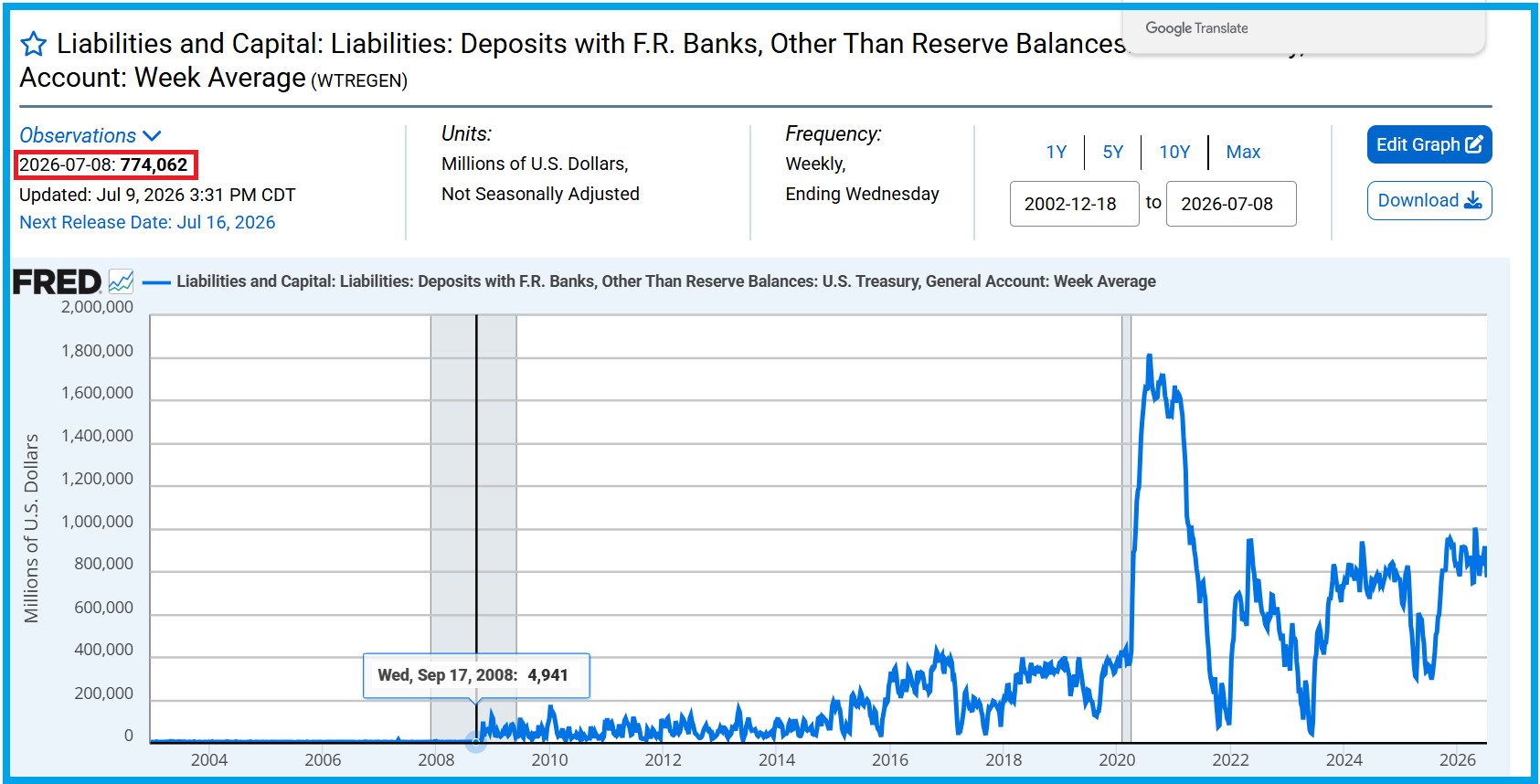
Furthermore, FRED, the St. Louis Federal Reserve Bank’s database, specifies that the federal government’s cash balance is currently… 774 billion dollars, the latest figure published to date!
Document 2:
The U.S. government must pay federal government bills and repay maturing loans every day using funds provided by taxpayers—that is, their taxes.
However, until September 17, 2008, the U.S. government had been conducting these operations with cash reserves of only about… 5 billion dollars.
However, everything changed starting in September 2008: the government’s cash reserves first surged to $100 billion and then fluctuated up to $400 billion.
Worse still, in 2020, the government’s cash reserves skyrocketed to… $1,817 billion!
For what reasons did U.S. governments seek to accumulate cash reserves that were—and still are—completely out of proportion to their needs for financing expenditures?
No sensible answer has been given by the Secretary of the Treasury—all the more so because… no sensible questions have been asked of him on this subject!
The federal government’s cash reserves therefore currently stand at 774 billion dollars as of July 12, the latest figure published to date.
To determine the amount of the actual net federal debt, one must therefore subtract the astronomical amount of the federal government’s cash reserves (i.e., 774 billion dollars) from the previously determined debt amount, which is 31,709 billion dollars.
[31,709 – 774 = 31,866]
Furthermore, the U.S. government publishes the Fed’s balance sheet weekly, which shows… 4,503 billion dollars in government securities consisting of Treasury bills.
Document 3:
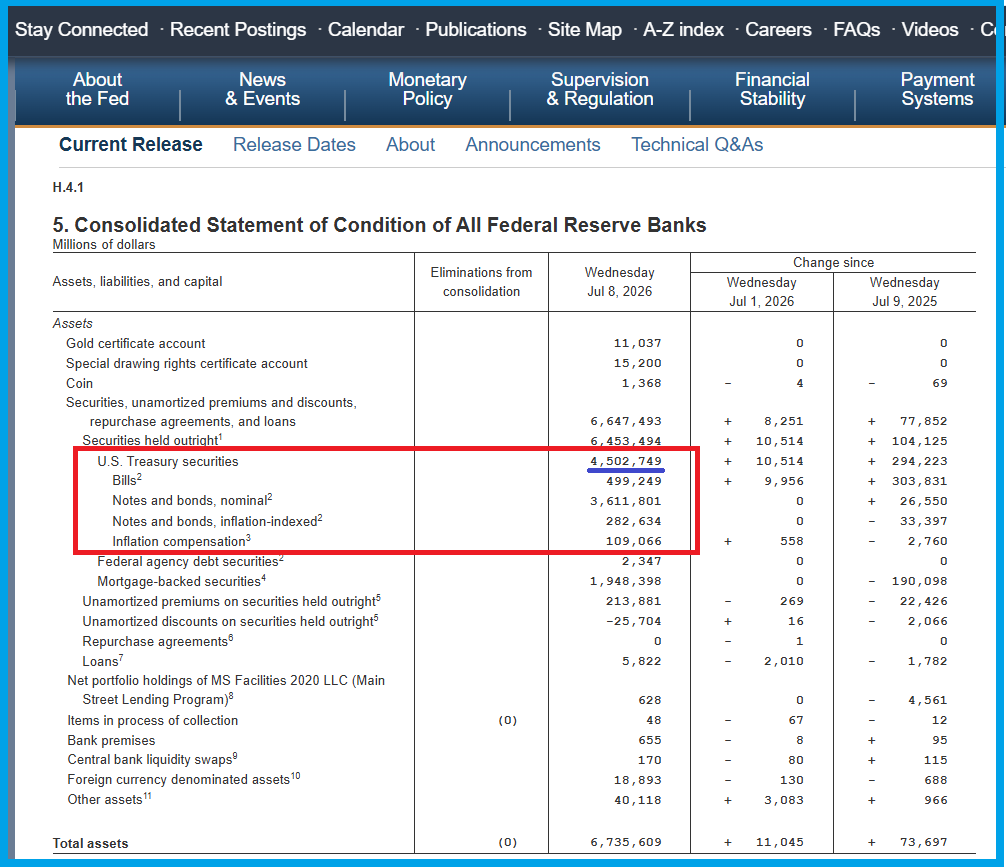
However, these 4,503 billion dollars are intended to be repaid by the federal government itself, and the Fed is supposed to return these funds to the federal government at the end of each fiscal year.
For the same reasons as before, we must therefore subtract these 4,503 billion dollars from the federal government’s debt amount determined earlier (i.e., 31,866 billion dollars) to obtain the actual net debt of the federal government, which is 26,432 billion dollars.
[31,866 – 4,503 = 26,432]
The federal government’s actual net debt is therefore ultimately 26,432 billion dollars, which can be compared to the current annual GDP of 31,866 billion dollars (as of June 25, 2026) according to the latest published figures,
Document 4:
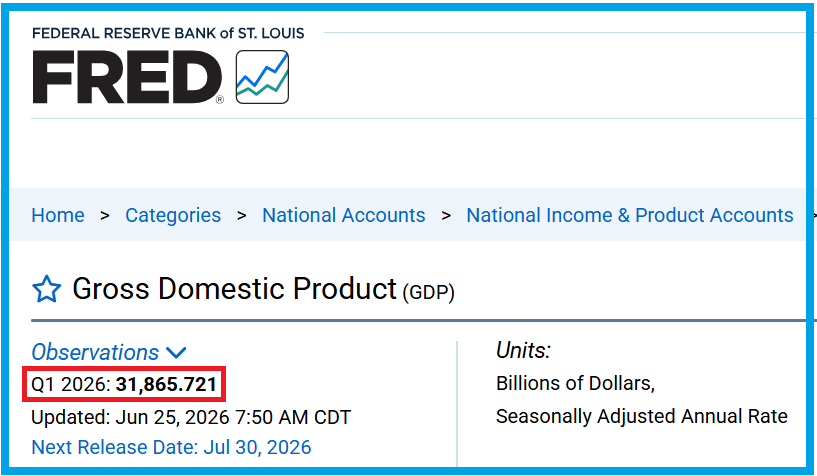
The federal government’s actual net debt therefore represents only… 82.95% of the annual GDP of the United States, which is considered normal, and not 120% as erroneously stated by everyone—and even by U.S. authorities!
[26,432 / 31,865 * 100 = 82.95%]
The first question that arises is this: why does everyone repeat the data published by U.S. authorities without even the most basic analysis?
The second question that arose in early 2025 was this: will the new Treasury Secretary Scott Bessent restore some order to the federal government’s cash management?
To date, the answer is clear: Scott Bessent has done nothing positive. He has only made the situation in America worse because, when he took office as Treasury Secretary, this debt ratio was only 80.1%, as noted in my article of February 2, 2025!
***
Summary table showing the transition from the United States’ gross debt to its net debt,
Document 5:
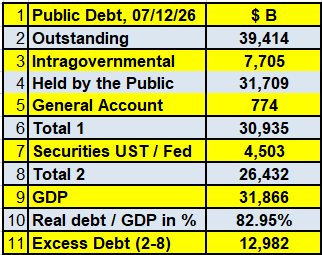
The difference between the gross debt—39,414 billion dollars—and the net debt—26,432 billion dollars—of the United States is therefore… 12,982 billion dollars (line 11 of Document 5)!
Thus, $13,000 billion has been improperly subtracted from the U.S. M3 money supply to obscure the magnitude of the monetary bubble that has developed there since the end of the Cold War!
This $13,000 billion in excess money is in addition to the $14,000 billion found in the M3 money supply that I have reconstructed.
Thus, there are 27,000 billion U.S. dollars unduly in circulation, creating a monetary hypertrophy that is lethal in the long run, meaning at some unspecified point in the future—though it is certain that this bubble will condemn America to a historic momentum crash unlike anything this country has ever seen.
Document 6:
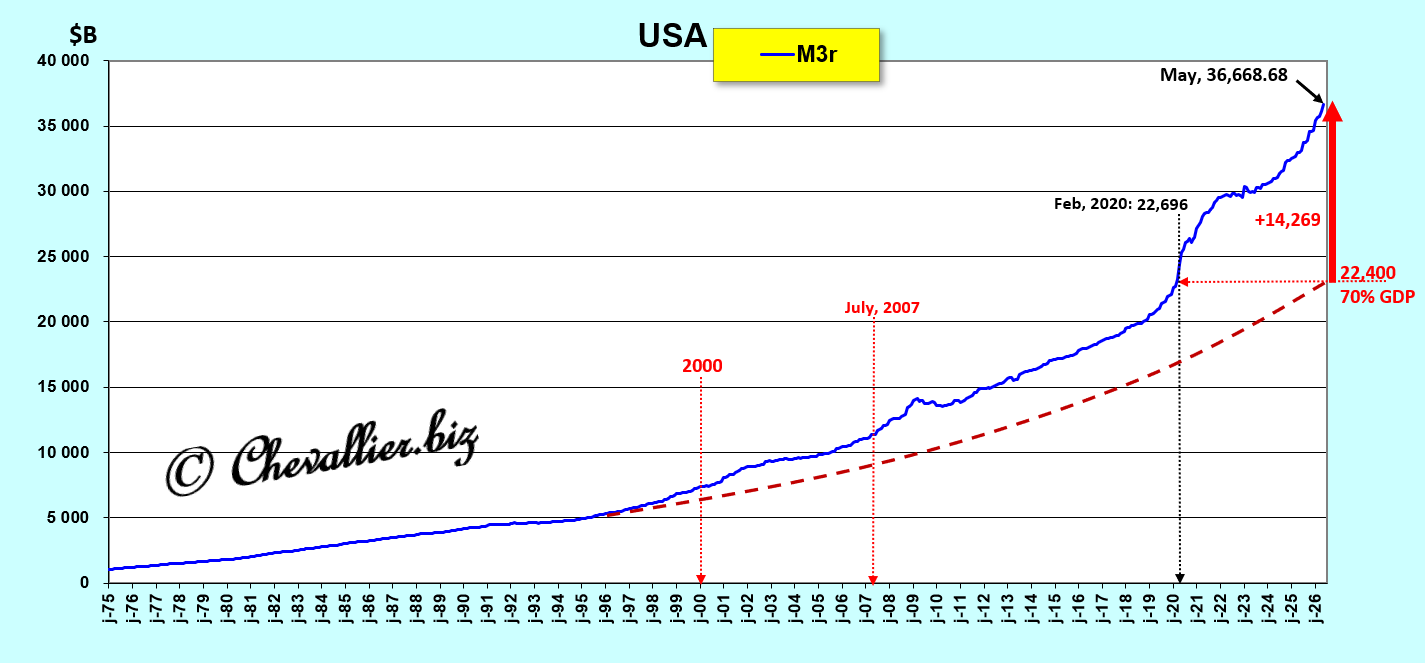
The big problem facingAmerica is not its debt, but its monetary hypertrophy, which far exceeds normal levels—see my articles on this subject!
This is why those who manipulate financial markets and public opinion lead the ignorant and passive common people to believe—through highly effective propaganda, since everyone buys into it—that U.S. public debt is a major and serious problem, which is not the case, while concealing the existence of this monetary bubble, and it is this bubble that poses the biggest problem—and such a bubble is always lethal in the long run!
The size of U.S. public debt is therefore a red herring, a trap.
It is surprising that I am the only one, to my knowledge, to have identified this by analyzing it in an irrefutable manner, since all my sources are official, and my methodology is reproducible.
As a reminder, sound money is the first pillar of Reaganomics and of monetarism, according to Arthur Laffer.
***
Click here to access the U.S. government website page that publishes the federal government’s debt figures on a day-to-day basis.
Click here to access the page on the St. Louis Federal Reserve Bank’s FRED database that publishes U.S. Treasury cash flow figures.
Click here to access the page on the Fed’s website that publishes its latest balance sheet.
Click here to access the page on the FRED website that publishes GDP figures.
Click here to read my April 19, 2025, article on this topic.
Click here to read my previous article on this topic.
Click here to read this article on my website in French.
©Chevallier.biz