




The actual net debt of the U.S. federal government is not 40,000 billion dollars, as those who manipulate financial markets and public opinion would have us believe, but 26,900 billion dollars.
It masks a very real monetary bubble of… 13,000 billion dollars!
The federal government’s self-held debt must logically and legitimately be written off, which would reduce interest payments by one-third- and lower-income taxes for Americans by 400 billion dollars!
***
The U.S. government publishes the federal government’s gross debt figure daily; as of September 8, 2026, it stands at… 40,103 billion dollars (Total Public Debt Outstanding, circled in red), which is a staggering amount and is what frightens everyone!
Document 1:
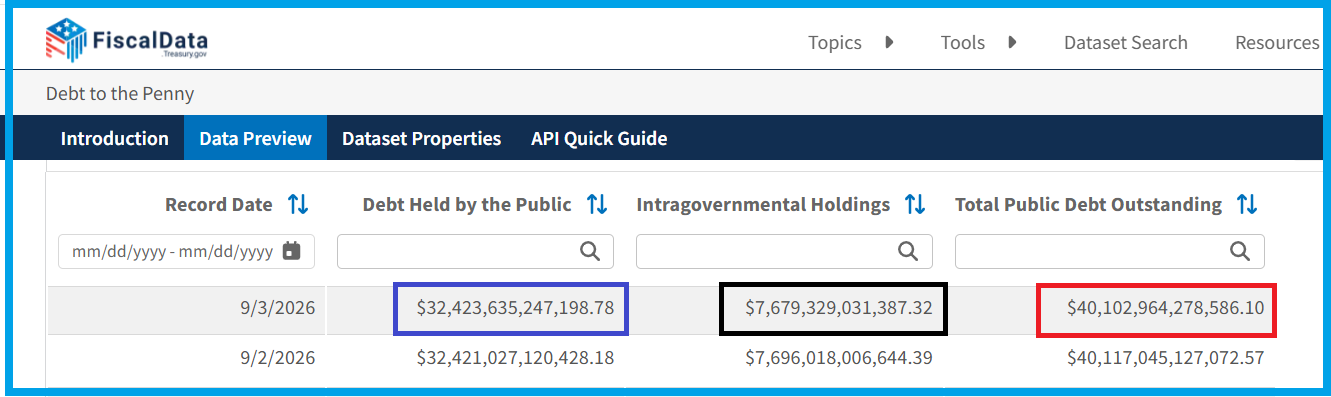
However, this document shows that government entities (Intragovernmental Holdings) hold 7,679 billion dollars of this federal debt (circled in black), which means that the federal government has both these debts and these claims against… itself!
To determine the actual amount of the net federal debt at this point, we must subtract from the gross debt the amount of debt the federal government holds on itself—that is, these 7,679 billion dollars (circled in black)—which brings the actual net federal debt down to 32,424 billion dollars (Debt Held by the Public, circled in blue).
[40,103 – 7,679 = 32,424]
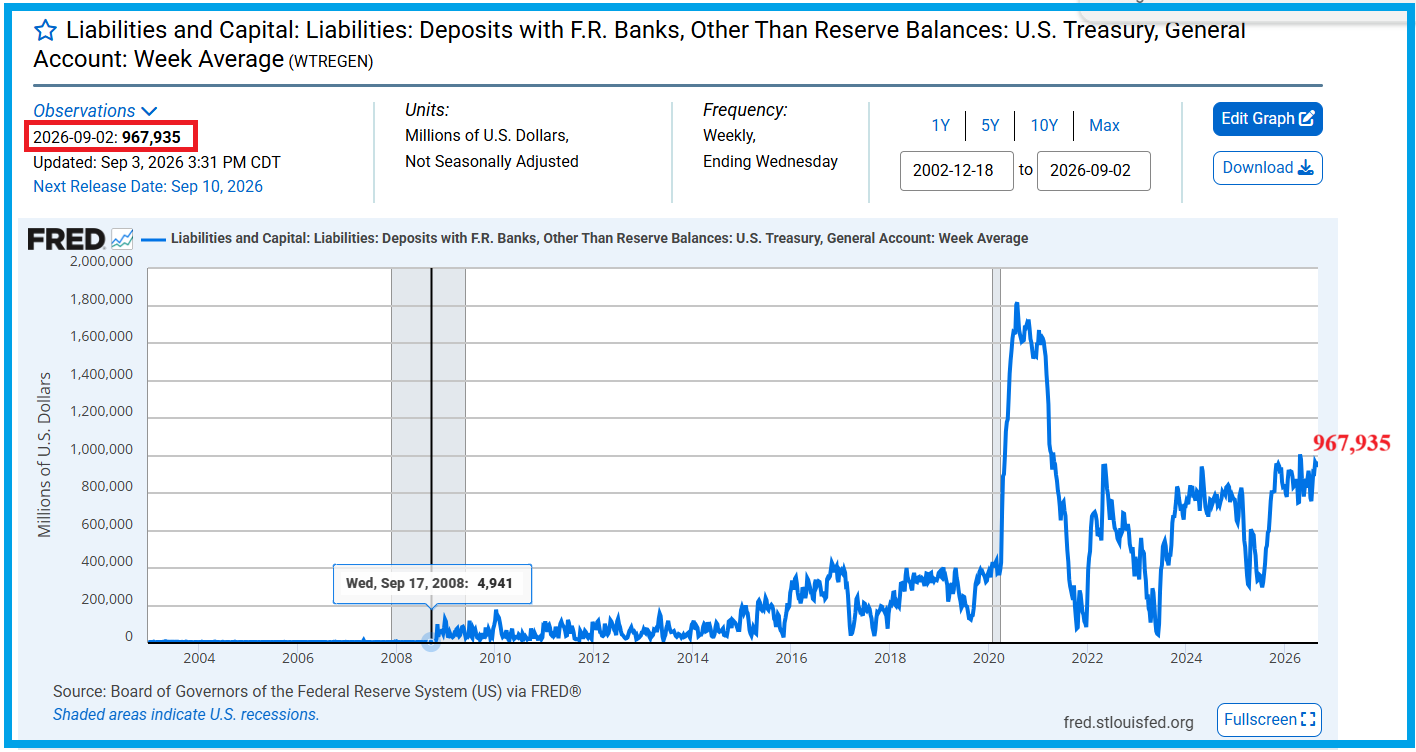
Furthermore, the Federal Reserve Bank of St. Louis’s FRED database specifies that the federal government’s cash balance is currently… 968 billion dollars—the latest figure published to date!
Document 2:
To understand this issue, one must consider that the U.S. government must pay federal government bills and repay maturing loans every day using resources provided by taxpayers—that is, their taxes.
However, until September 17, 2008, the U.S. government carried out these operations with a cash balance of only about… 5 billion dollars.
However, everything changed as of September 17, 2008: the government’s cash reserves first surged to $100 billion and then fluctuated up to $400 billion.
Worse still, in 2020, the government’s cash reserves skyrocketed to… $1,817 billion!
For what reasons did U.S. administrations seek to accumulate cash reserves that were—and still are—completely out of proportion to their needs for financing government expenditures?
No sensible answer has been provided by the successive Secretaries of the Treasury—all the more easily… since no sensible questions were ever asked of them on this subject!
The federal government’s cash balance therefore currently stands at 968 billion dollars as of September 8, 2026, the latest figure published to date.
To determine the amount of the actual net federal debt at this level, one must therefore subtract the astronomical amount of the federal government’s cash reserves (i.e., 968 billion dollars) from the previously determined debt amount, which is 31,456 billion dollars.
[32,424 – 968 = 31,456]
Furthermore, the U.S. government publishes the Fed’s balance sheet weekly, which lists among its assets… 4,552 billion dollars in government securities consisting of Treasury bills.
Document 3:
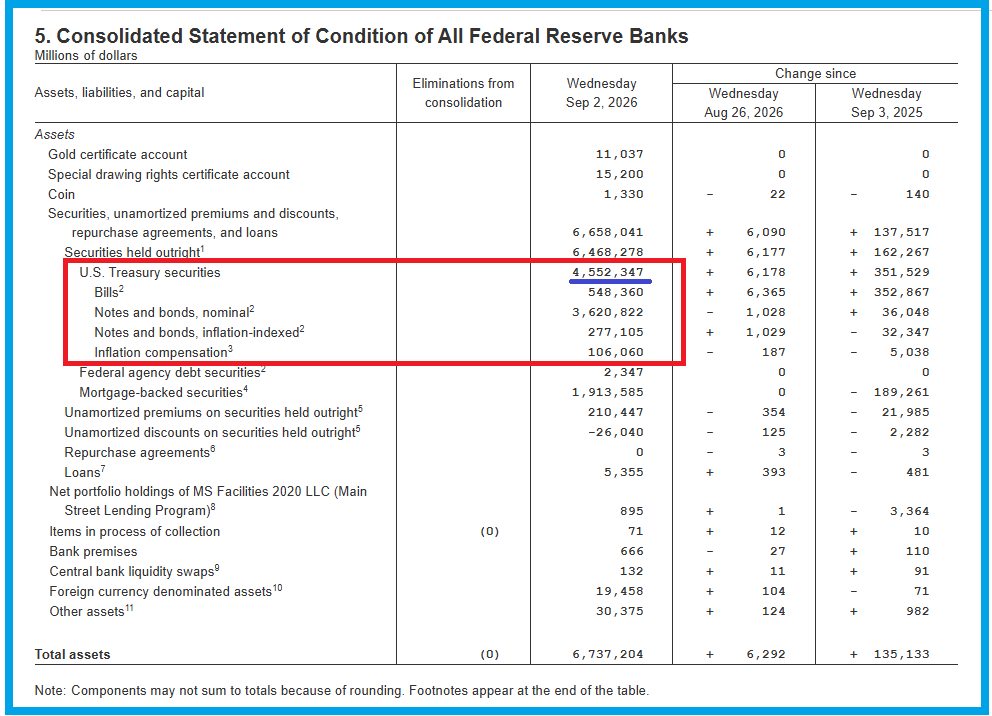
However, these 4,552 billion dollars are intended to be repaid by the federal government itself, and the Fed is supposed to return these funds to the federal government at the end of each fiscal year.
For the same reasons as before, we must therefore subtract these 4,552 billion dollars from the federal government’s debt amount determined earlier (i.e., 31,456 billion dollars) to obtain the actual amount of the federal government’s net debt, which is 26,903 billion dollars (taking into account the hundreds of millions of dollars).
[31,456 – 4,552 = 26,903]
The federal government’s actual net debt is therefore ultimately 26,903 billion dollars, which can be compared to the current annual GDP of 32,486 billion dollars (as of August 26, 2026) according to the latest figures published to date,
Document 4:
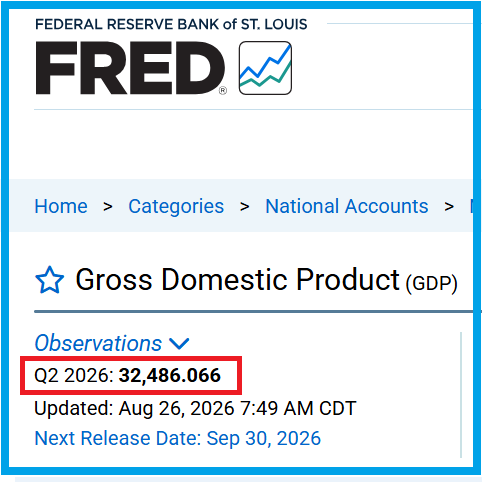
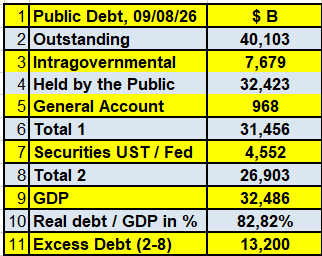
The federal government’s actual net debt therefore represents only… 82.82% of the annual GDP of the United States, which is considered to be nearly normal, and not 120% as erroneously stated by everyone—and even by U.S. authorities!
[26,903 / 32,486 * 100 = 82.82%]
Summary table showing the data on the transition from gross to net debt in the United States,
Document 5:
***
After this brief analysis of the federal debt, a few questions arise…
The first question that arises is this: why does everyone accept, without even the most basic analysis, the federal debt figures published by U.S. authorities—namely, a debt of 40,000 billion dollars?
My analysis above is, however, simple—and all the more easily understandable given that the official data provides a clear starting point by distinguishing between gross debt and a portion of net debt.
This lack of reflection is astonishing. It reveals a worrying level of understanding of the most basic financial issues on the part of a population that has, nevertheless, developed particularly sophisticated financial services.
The second question that arose in early 2025 was this: will the new Secretary of the Treasury, Scott Bessent, restore some order to the management of the federal government’s cash flow?
To date, the answer is clear: Scott Bessent has only made matters worse for America because, when he took office as Treasury Secretary, this debt-to-GDP ratio was only 80.1%, see my article from February 2, 2025, whereas today that ratio has risen to 82.8%, representing an increase of 3,111 billion dollars relative to a net debt of 23,792 billion dollars!
***
The difference between the federal government’s gross debt—40,103 billion dollars—and its net debt—26,903 billion dollars—is therefore… 13,200 billion dollars (line 11 of Document 5)!
These $13,200 billion in extraordinary debts are inflating the U.S. M3 money supply, creating the monetary bubble that has been developing there since the end of the Cold War!
In fact, this $13,200 billion in monetary excess corresponds to the $13,560 billion in excess found in the M3 money supply that I have reconstructed; see my articles on this subject.
Thus, more than 13,000 billion U.S. dollars are unduly in circulation and form a monetary bubble that is always lethal “in the long run”, which means, “at some unspecified point in the future,” but it is certain that this bubble dooms America to a historic momentum crash unlike anything this country has ever seen.
Document 6:
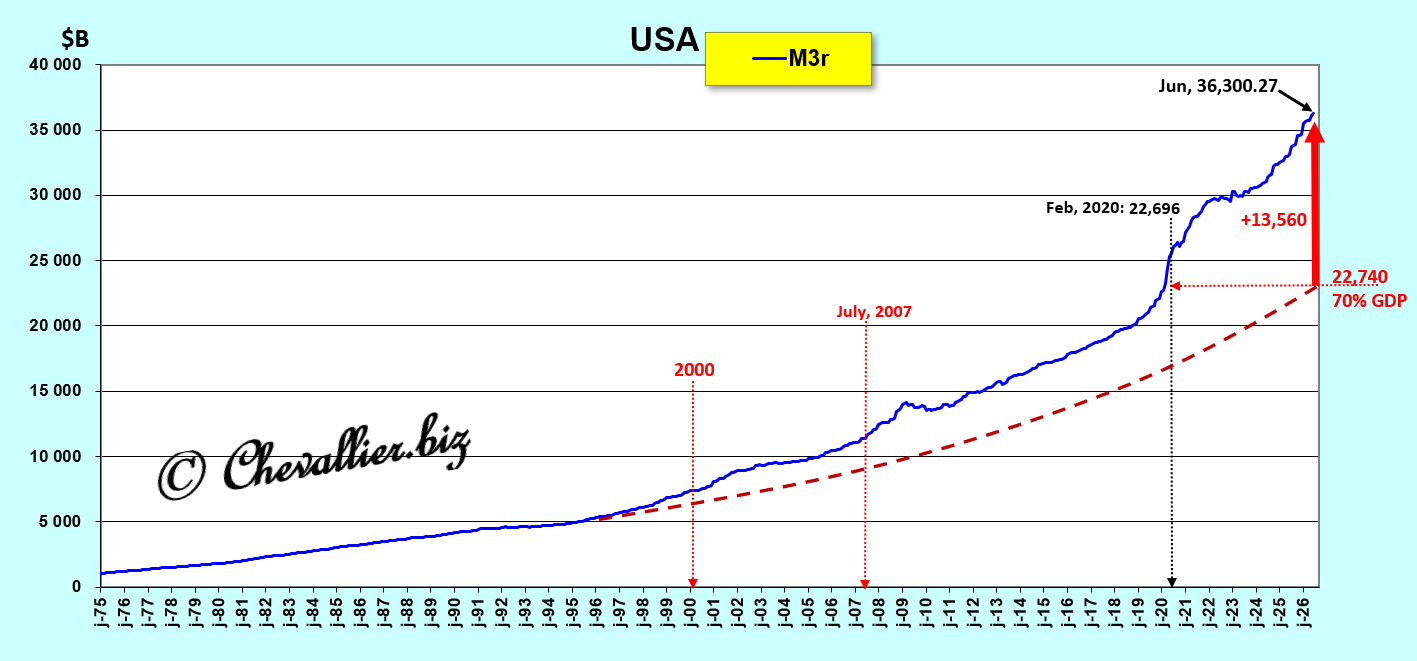
The big problem facingAmerica is not its debt, but its monetary bloat, which far exceeds normal levels—see my articles on this subject!
In fact, it appears that the U.S. M3 money supply corresponds to 111.7% of current annual GDP, whereas this ratio should fluctuate around 70% and must under no circumstances exceed the 80% limit—see my articles on this subject!
Document 7:
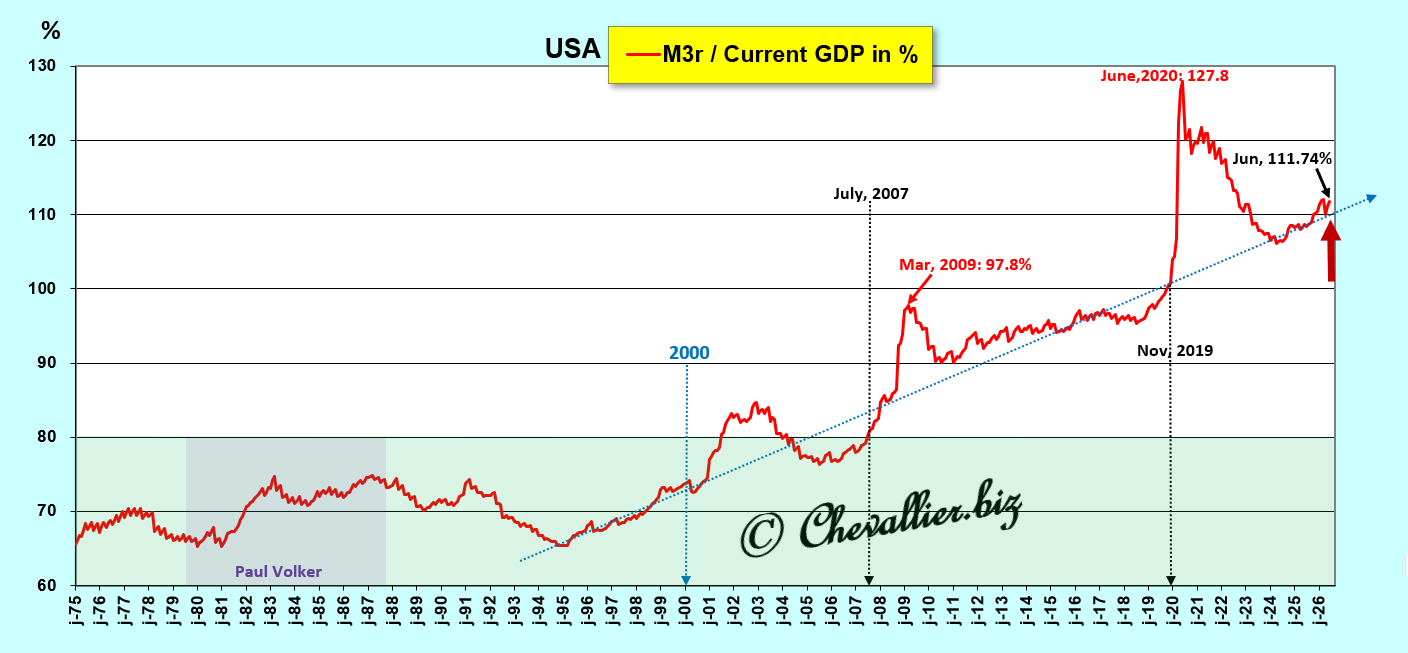
Those who manipulate financial markets and public opinion lead everyone to believe that U.S. public debt is a major and serious problem, which is not the case.
In doing so, they obscure the existence of this monetary bubble—and it is this bubble that poses the biggest problem, and such a bubble is always fatal in the long run!
The magnitude of U.S. public debt is therefore a red herring, a trap.
It is surprising that I am the only one, to my knowledge, to have identified this by analyzing it in an irrefutable manner, since all my sources are official and verifiable, and my methodology is reproducible.
As a reminder, sound money is the first pillar of Reaganomics and of monetarism, according to Arthur Laffer.
***
The problem posed by the difference between the federal government’s gross debt ($40,103 billion) and its net debt ($26,900 billion)—a difference of $13,200 billion—means that the federal government owes a debt to… itself!
However, according to the following indisputable accounting principle: any debt owed to oneself is cancellable, so an excellent idea would be to… actually cancel it!
This would eliminate any significant difference between gross debt and net debt, as was the case during the second half of the 20th century.
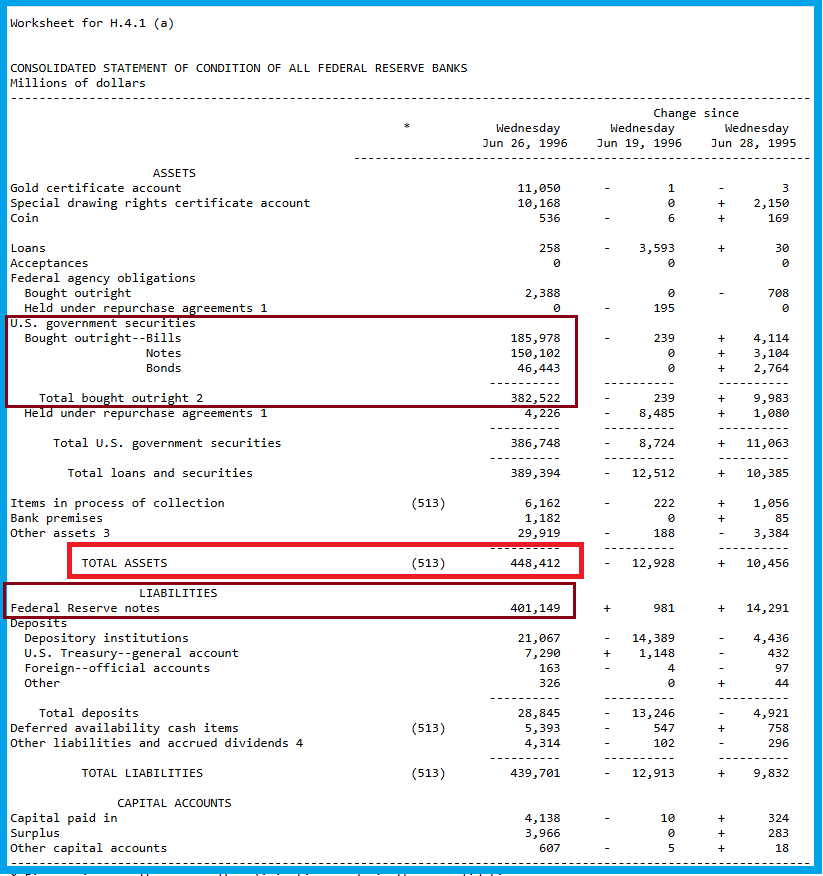
In fact, the Treasury’s cash balance was then less than $10 billion (see Document 2 above), and the Treasury bills held by the Fed in June 1996 (the earliest date for which this data is currently available) show that they totaled $382.5 billion against a current GDP of $8,032.8 billion, resulting in a ratio of 4.76%, whereas that ratio currently stands at 14.0% (see the figures in Documents 4 and 3 above).
Document 8:
So, to return to a conclusion that should be of interest to most American taxpayers, the legitimate cancellation of one-third of the federal government’s gross debt of $40,103 billion—that is, $13,200 billion—would eliminate one-third of the interest paid by the Treasury to holders of its bonds, which totaled $1,247 billion at the end of the second quarter of last year, amounting to… 400 billion dollars!
Document 9:
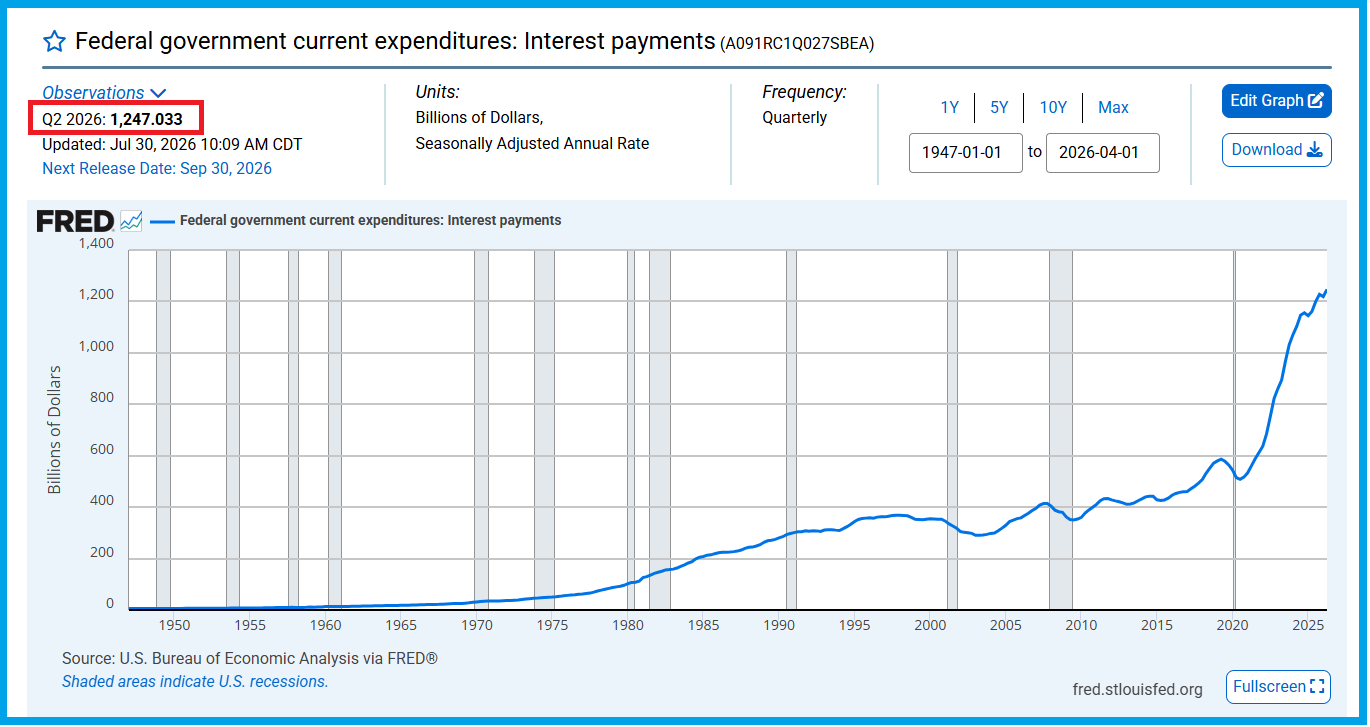
In other words, the legitimate cancellation of one-third of the federal government’s net debt to itself would reduce the taxes paid by U.S. taxpayers by… 400 billion dollars, all other things being equal!
A $400 billion reduction in federal income taxes out of a total of $2,370 billion represents an overall decrease of 16.9%… which should increase the appeal of this cancellation of the federal government’s net debt to itself, a measure that could be proposed by… a third party.
Document 10:
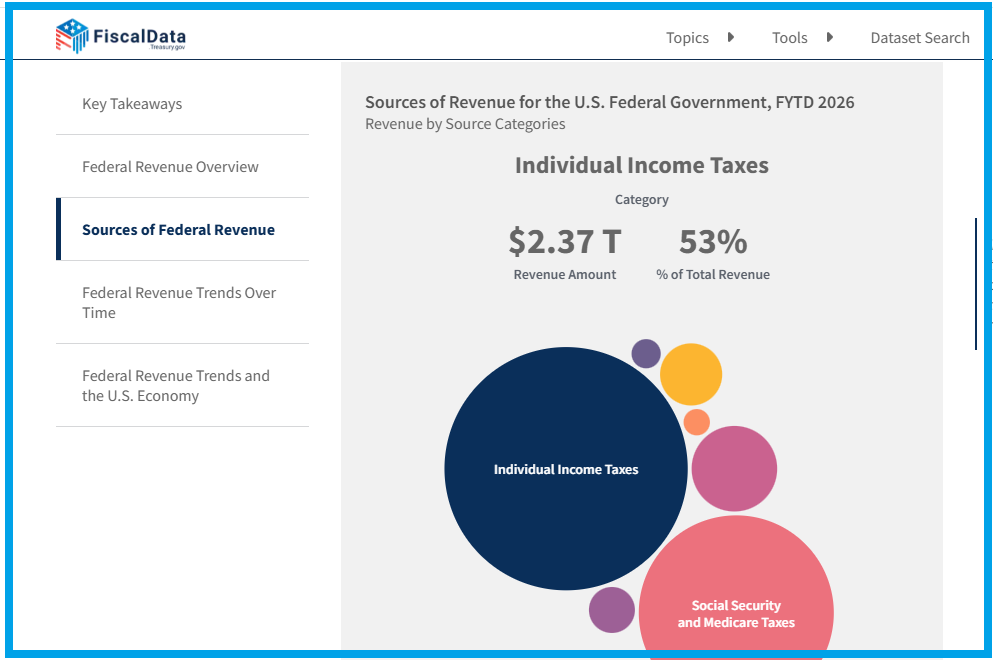
The icing on the cake: reducing the amount of this debt would drive up the prices of Treasury bonds held by the public and lower their yields.
The legitimate cancellation of the federal government’s self-held debt would therefore create nothing but winners!
This raises a question: why is the federal government’s self-held debt so large?
The answer is simple and obvious…
Those who manipulate financial markets and public opinion have succeeded in convincing everyone (or almost everyone!) to provide liquidity to all entities on the brink of bankruptcy that have recklessly invested in financial products that should never have been developed.
By buying back U.S. Treasury bonds, the federal government is thus injecting $13,000 billion into the U.S. financial system… funded by U.S. taxpayers!
During the second half of the 20th century, the fight against communism forced the monetary authorities of the Free World to maintain sound money in those countries, which was the first pillar of Reaganomics, according to Arthur Laffer.
However, after the fall of the USSR, those who manipulate financial markets and public opinion succeeded in imposing their demands by allowing financial markets to run wild, which fueled this $13,000 billion monetary bubble.
***
Another question arises: how is it that no one—that is, no individual or political party—is presenting a platform proposing the cancellation of the federal government’s debt to itself?
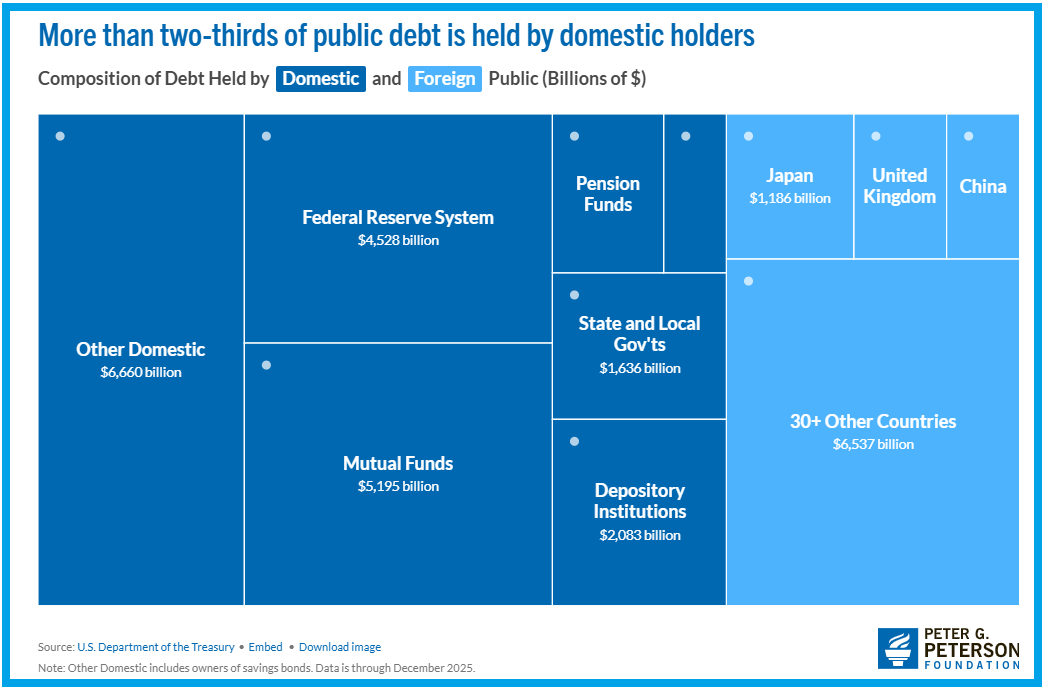
To my knowledge, only the Peter Peterson Foundation publishes relevant studies on federal government debt, but without mentioning the issue of the portion held by the federal government itself, its legitimate cancellation, or its consequences.
Document 11:
***
Once again, it was my loyal reader, Corinne, who put me on the trail of this issue of the government’s debt to itself in the context of the eurozone’s Treasury bond buyback programs…
In fact, Matthieu Pigasse, director of the Paris office of the American investment bank Centerview Partners, very cleverly convinced Jean-Luc Mélenchon, the leader of the… far-left (!) La France Insoumise—to propose, as part of his campaign for the upcoming 2027 French presidential election, the cancellation of 600 billion euros of the French government’s debt to itself, which would save… 25 billion euros in interest ultimately paid by French taxpayers (at a rate of 4%).
Of course, in France, everyone is fiercely opposed to this measure that no one understands—not even professionals in the financial sector!
As part of its regular consulting activities, the U.S. arm of Centerview Partners should make such a proposal to the U.S. government, since no other individual or party is doing so!
Yet any politician or party that proposed lowering taxpayers’ overall tax burden by 16.9 percent—and possibly eliminating this federal tax for the millions of Americans with the lowest taxable income—could potentially win the votes of those millions of voters!
***
For those who might not fully understand thata government’s debt to itself must be canceled, this little story helps make it clear…
Mr. Johnson wants to borrow $1 million to develop a project. None of the proposals presented to him by financial institutions meet his needs.
Finally, Ms. Smith offers him a contract that satisfies him. The deal is done.
But sometime later, Mr. Johnson and Ms. Smith get married under the community property regime. They now form a single financial entity: the Johnson-Smith couple.
What happens to Mr. Johnson-Smith’s debt to Mrs. Johnson-Smith?
It must obviously be canceled because Mr. Johnson-Smith cannot owe a debt to himself, nor can he repay it, since he is part of the (financial) Johnson-Smith couple.
Maintaining such a debt is inconceivable… and yet many states continue to record debts owed to themselves and make taxpayers pay the interest on them!
***
Click here to access the U.S. government website page that publishes the federal government’s debt balance on a day-to-day basis.
Click here to visit the page on the St. Louis Federal Reserve Bank’s FRED database that publishes U.S. Treasury cash flow figures.
Click here to visit the Fed’s website page publishing its latest balance sheet.
Click here to visit the FRED website page publishing GDP figures.
Click here to read my February 2, 2025, article on this topic (in French).
Click here to access the page on the Fed’s website publishing its balance sheet as of the end of June 1996.
Click here to access the page on the U.S. government’s website publishing the interest payments on the federal government’s debt.
Click here to access the Peter Peterson Foundation’s webpage on federal government debt.
Click here to read my previous article on this topic.
©Chevallier.biz